TB-500
5mg · Lyophilized
98.6%
$62View
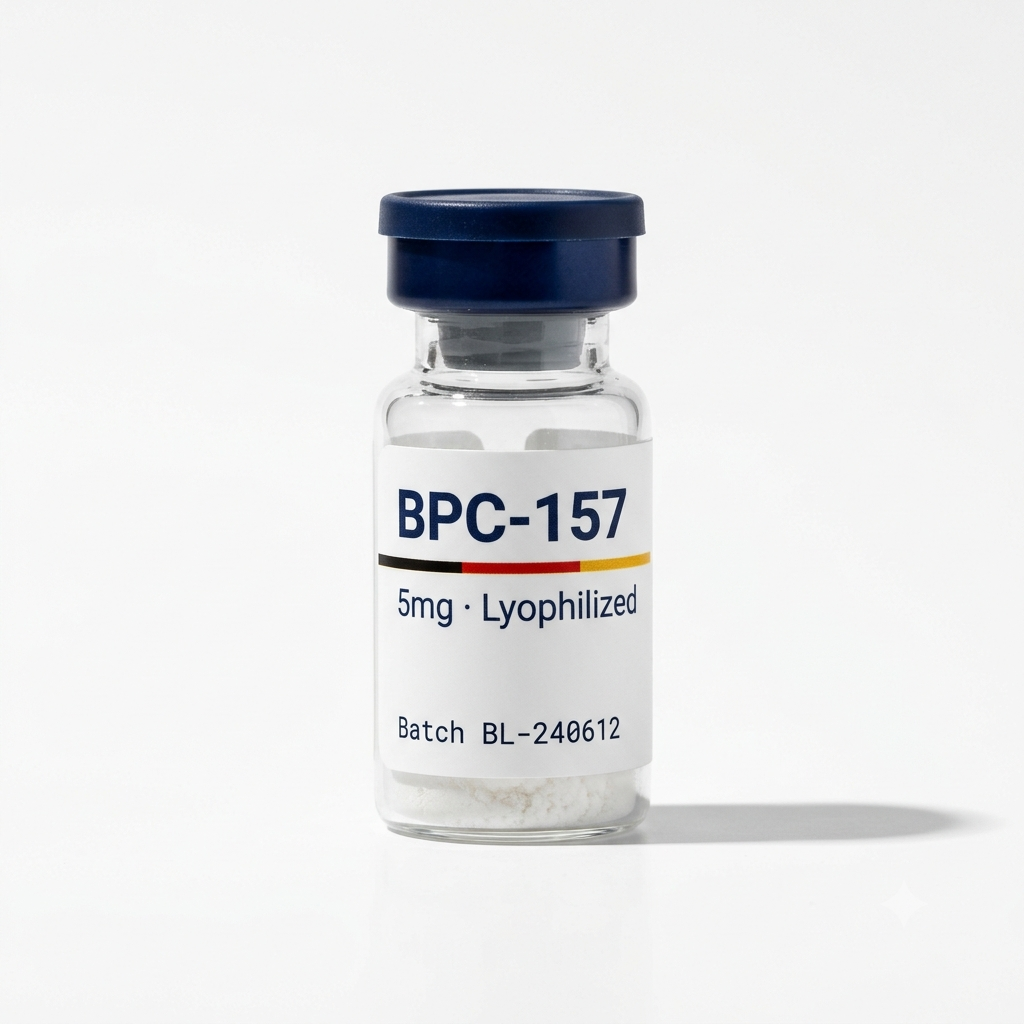
5mg · Lyophilized · Batch BL-240612
For research use only. Not for human consumption. Ships within 24h from US cold storage at −20°C. Temperature log included.
BPC-157 and TB-500 appear together in multiple published tissue repair studies. Available as a combined research set at 15% discount.
View BPC-157 + TB-500 research setRepresentative chromatogram. Main peak at 12.4 min corresponds to BPC-157. Area percentage: 99.1%. Actual COA PDF contains full instrument data.
BPC-157 (Body Protection Compound-157) is a synthetic 15 amino acid peptide with the sequence GEPPPGKPADDAGLV. It was identified as a fragment of a larger protein found in human gastric juice. The parent protein has been studied since the 1990s, primarily by Predrag Sikiric and colleagues at the University of Zagreb, whose laboratory has produced the majority of published BPC-157 research over three decades.
As a synthetic compound, BPC-157 has no endogenous source — it does not occur naturally in the body at concentrations relevant to the published research. It is classified as a research peptide and is not an approved drug in any jurisdiction.
The most extensively documented mechanism in BPC-157 research involves VEGF (vascular endothelial growth factor) upregulation and activation of the VEGFR2 signalling pathway. Published studies in rodent models demonstrate that BPC-157 promotes the formation of new blood vessels in injured tissue, a process called angiogenesis. New capillary formation is relevant to tissue repair research because injured tissue requires oxygen and nutrient delivery from newly formed vasculature to support cell proliferation and matrix synthesis.
BPC-157 has also been studied in the context of nitric oxide (NO) pathway modulation. Research indicates activation of endothelial nitric oxide synthase (eNOS), increasing local NO production. Nitric oxide functions as a vasodilator and plays regulatory roles in inflammation, cell survival signalling, and vascular tone. Several of the gastroprotective effects documented in BPC-157 research are attributed to NO-mediated mechanisms.
BPC-157 has been examined for its effects on tendon fibroblast proliferation and migration. Fibroblasts are the primary cell type responsible for synthesising collagen and extracellular matrix proteins in connective tissue. In cell culture and rodent studies, BPC-157 stimulates fibroblast activity, with researchers proposing this as a mechanism for the accelerated tendon and ligament repair observed in animal models.
Published research has also examined growth hormone receptor upregulation in healing tissue. BPC-157 appears to sensitise injured tissue to growth hormone signalling without altering systemic GH levels — a mechanistically distinct effect from direct GH administration.
The compound was originally characterised in the context of gastric mucosal protection. Rodent studies have examined BPC-157 in models of NSAID-induced gastric damage, alcohol-induced lesions, and stress ulcers. The gastroprotective effects appear to be mediated through the nitric oxide pathway and local prostaglandin modulation. Research has also examined effects on gut motility and intestinal anastomosis healing.
A separate body of research has examined BPC-157 in neurological contexts, including dopaminergic and serotonergic system modulation. Published studies report effects on dopamine and serotonin receptor expression in rodent models, with some researchers proposing applications in stress and anxiety research. The neurological mechanisms are less characterised than the vascular and connective tissue mechanisms.
Strong: In vitro mechanistic data and rodent model data across multiple independent laboratories for angiogenesis, fibroblast activation, and gastroprotection. The mechanistic basis is well-characterised at the molecular level.
Limited: Human controlled trial data. To date, BPC-157 has not completed Phase II or Phase III clinical trials. Evidence for human application extrapolates from animal models. The rodent-to-human translation for this compound is not established.
Researchers should note that the FDA removed BPC-157 from the list of bulk drug substances eligible for compounding in 2023-2024, citing its status as an active pharmaceutical ingredient under clinical investigation.
Lyophilized powder: store at -20°C, protected from light and moisture. Do not freeze-thaw repeatedly. Stable for 24 months under correct conditions.
Long-term: -20°CReconstitute with bacteriostatic water or sterile water for injection. Add solvent slowly along the vial wall. Do not shake — gently swirl until fully dissolved.
Solvent: bacteriostatic waterOnce reconstituted, store at 4°C and use within 30 days. Do not return reconstituted solution to the freezer. Discard if solution appears cloudy or contains particulates.
Reconstituted stability: 30 days15 amino acid peptide. Research focus: angiogenesis (VEGF pathway), fibroblast activation, nitric oxide modulation, gastroprotection. Acts primarily via vascular and extracellular matrix mechanisms.
Full comparisonThymosin Beta-4 fragment. Research focus: actin-binding, cell migration, anti-inflammatory cytokine modulation. Distinct mechanism from BPC-157. Studied in combination in multiple published tissue repair papers.
View TB-500